
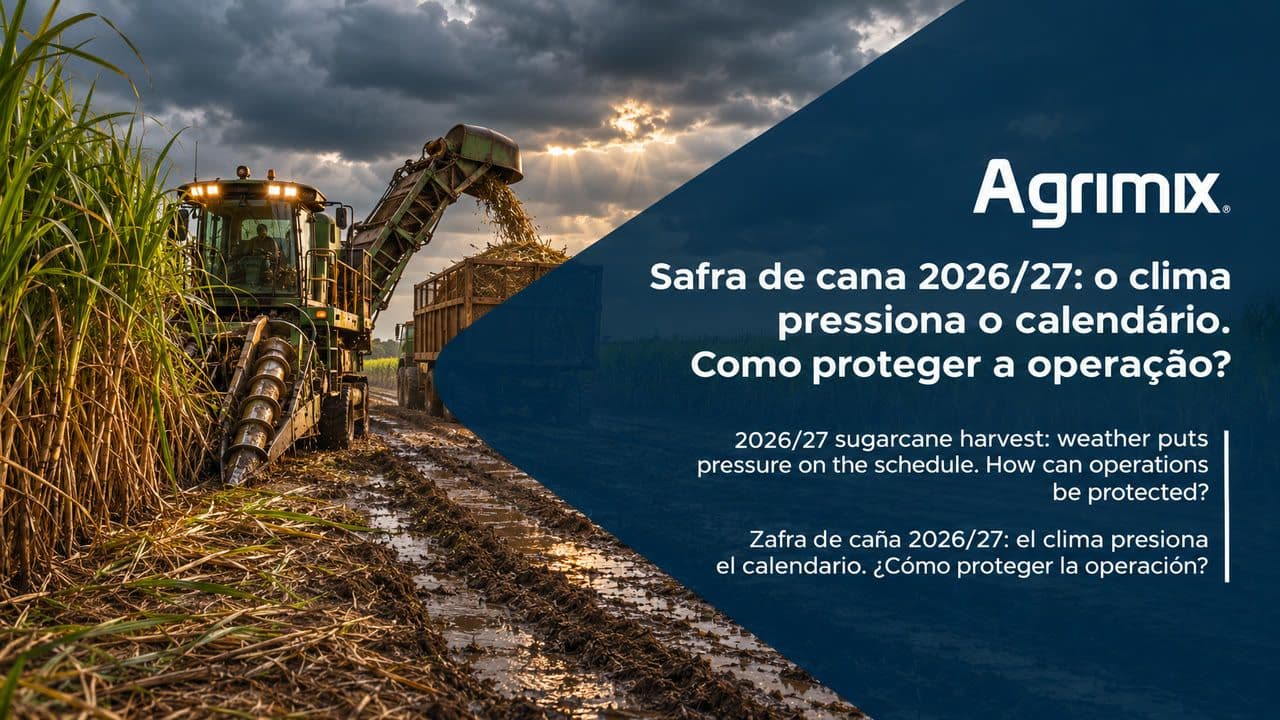
2026/27 sugarcane harvest: weather puts pressure on the schedule. How can operations be protected?
The sugarcane harvest in Guatemala is scheduled to begin on November 6, amid concern over the effects of lower rainfall and high temperatures. In Mexico, there is a rainfall alert for mill start-ups. In Brazil, recent surveys have already pointed to harvest interruptions caused by excess water.
The scenarios are different, but they raise a common question for management in the sugar-energy sector: how can you make the most of the hours available for work when the schedule may change?
In Agrimix's analysis, the answer involves integrating maintenance, parts replacement, fleet availability and industrial capacity. Planning needs to consider both the production forecast and the conditions required to harvest, transport and process the cane.
What does the news indicate for the 2026/27 sugarcane harvest?
Comparing markets helps identify risks, but it requires attention to the differences between a weather forecast, a production estimate and an interruption that has actually been observed.
Guatemala: harvest starts with expectations of lower production
According to a report by República published on October 31, the first mills in Guatemala are scheduled to start operating on November 6.
In the article, the general manager of the Guatemalan Sugar Producers Association, Asazgua, links the expectation of lower production to reduced rainfall and high temperatures. The impact was still being assessed, with no final figure for the decline. Each mill sets its calendar based on weather, harvest planning and industrial tests.
For management, this scenario opens a discussion about making the most of the crop: when agricultural productivity is under pressure, it becomes even more important to examine avoidable losses in the stages that follow.
Mexico: watching for rain as mills start up
In a news item from October 30, Zafranet reported that Conadesuca identified 11 mills on alert for possible rain at the start of the 2026/27 harvest.
The calendar presented schedules start-ups throughout November and December. The article stresses that the weather alert does not confirm a delay.
The implication for planning is to work with alternatives: which activities can be reorganized if access to the field becomes limited? And which conditions must be met to start the operation safely?
Brazil: rain has already affected the pace of the harvest
In Brazil's Center-South, an S&P Global survey published on October 9 pointed to the effects of rain on the harvest and on cane availability.
Market participants estimated about 8.5 days of weather-related interruptions throughout September. The survey also projected a drop in sugar production in the second half of that month. These figures are estimates for the period analyzed, not consolidated results for November.
The Brazilian case helps put the restart at the center of the discussion: when conditions allow work again, the structure must be ready to respond.
Why is operational availability becoming more important?
An operation may have enough machines on paper and still not have all of them available when it needs them.
The difference lies between planned capacity and available capacity. A harvester awaiting diagnosis, a transshipment vehicle not yet cleared for work or a part still in transit must appear in the plan as concrete constraints.
Consider a hypothetical situation: after a rain interruption, the soil and access conditions allow the harvest to resume. Part of the fleet, however, remains down for maintenance that depends on a component that has not yet been purchased.
In this case, the operation has to deal with two waiting times: the one imposed by the weather and the one needed to resolve the mechanical unavailability.
The priority proposed by Agrimix is to reduce the overlap between these risks. This requires knowing what is pending, assigning owners and tracking deadlines before clearing the restart.
How can you prepare harvesters and parts for a variable schedule?
Preparation can start with four management decisions.
1. Prioritize components by the consequence of failure
The price of the part, on its own, is not enough to set priorities.
When assessing criticality, consider:
- The effect of the failure on safety and operation.
- The history of inspections and replacements.
- The component's replacement lead time.
- The availability of technically compatible alternatives.
- The time needed to carry out the repair.
This analysis helps distinguish what can wait for a scheduled intervention from what requires action in advance.
2. Check the application before buying
A generic description can leave doubts about which part is needed. Whenever possible, gather the part number, machine model, serial number and information about the application.
When requesting a quote, also confirm quantity, availability and delivery time. In international operations, include shipping and customs clearance in the plan.
The goal is to make the decision with a complete delivery forecast, rather than considering only the date the part leaves the supplier.
3. Update the real status of the fleet
A machine list should show which units are cleared for work, which have restrictions and which depend on maintenance.
For each pending item, record the diagnosis, required components, person responsible and expected completion date. This makes it possible to organize how machines are allocated and to revise the plan as conditions change.
Tracking also prevents maintenance that has started from being treated as if it were already finished.
4. Use interruptions to review the plan
When conditions are safe and the right structure is in place, a pause in the harvest may allow previously scheduled inspections or services to be carried out.
This opportunity should be assessed by the responsible team, following maintenance procedures and the manufacturer's guidelines. Not every intervention fits into the available time, and starting a job without the resources to finish it can jeopardize the restart.
The decision must consider duration, crew, tools and components already on hand.
Mill readiness must keep pace with the fleet
The analysis must extend to industrial processing. Harvesting, transport and crushing need to share information to adjust the pace of work.
Before a restart, it is worth checking whether the field schedule is compatible with cane reception and with plant conditions. Likewise, industrial constraints should be part of agricultural planning.
This coordination helps answer practical questions:
- What volume can be harvested and received in the period?
- Is any industrial intervention still pending?
- Is the transport fleet available?
- Which constraints require a change in the schedule?
The answers make it possible to plan the operation as a sequence of interdependent steps.
What do different countries teach about harvest planning?
The news shows that there is no single answer for every market. One region may face access difficulties due to rain, while another assesses the impact of water deficit on productivity.
That is why planning should consider local conditions, the stage of the harvest, the maintenance structure and the supply lead times of each operation.
Agrimix's view is that monitoring the weather needs to lead to operational decisions: reviewing priorities, bringing purchases forward when necessary, rescheduling services and aligning the fleet with industrial capacity.
This is one way to turn market information into preparation for work.
Frequently asked questions about availability during the sugarcane harvest
How do you decide which parts should be replenished in advance?
Assess the criticality of the application, the maintenance history, the supply lead time and the impact of a possible stoppage. The decision should follow the operation's technical analysis.
Can maintenance be carried out during a rain stoppage?
It depends on safety conditions, the work site and the resources available. Services must be planned and performed by qualified professionals, in accordance with the manufacturer's guidelines.
How can agricultural and industrial planning be integrated?
Share the harvesting, transport and crushing schedule, keeping the constraints of each stage visible. Update the plan whenever there is a change in weather, machine availability or plant capacity.
Prepare the operation to make the most of working conditions
The 2026/27 sugarcane harvest brings different challenges from one country to another. Following the news helps recognize these scenarios; operational preparation defines how each company can respond.
Agrimix works with replacement parts, agricultural machinery and industrial projects, connecting the needs of the field to the plant.
Send your parts list and your machine information to Agrimix to check application, availability and supply conditions.